This Nutrition Connection CE article appeared in the September/October 2026 issue of Nutrition & Foodservice Edge magazine. To view a PDF of this article click HERE.
To earn 1.0 GEN CE credit, purchase the CE article in the ANFP Marketplace HERE or click the button below and complete the quiz.

This course is a level III continuing competence. View continuing competence level descriptions HERE.

Beyond the Tray: Hospitality Through the Five Senses
By: Kristin Klinefelter, MS, RDN, LDN
When was the last time you felt welcomed somewhere? What stood out? Who made you feel welcome? In your mind’s eye, picture the scene. Now remember what sounds you heard (or didn’t hear), the smells and tastes you experienced, and the way you felt.
Now picture two trays leaving the same kitchen, the same day, the exact same menu. One arrives lukewarm, stacked crooked, dropped off without a word. The other arrives at the right temperature, arranged carefully. The food on the tray looks attractive and appetizing. It is set down with eye contact from the employee who states: “Enjoy your meal. Is there anything else I can do for you?” Both trays were made with the same recipe and food cost. Yet, the guest had completely different experiences.
That gap is hospitality. As a Certified Dietary Manager, Certified Food Protection Professional you have the privilege to create the hospitable experience your guests receive.
When people think about your job as a CDM, CFPP, they likely think about food safety, diet orders, and budgets. Rightly so; that is the backbone of the work. Yet there’s another layer to what you do every single day. It’s just as much a part of your scope of practice as HACCP logs and menu costing: hospitality.
The Association of Nutrition & Foodservice Professionals (ANFP) has a philosophy: the dining experience is about more than eating. It’s aimed at the complete nourishment of individuals, including the emotional, spiritual, and physical components. That’s worth reading twice. It tells you something important: hospitality isn’t an extra task on your to-do list. It is built into the standard to which you are already held.
If you work in long-term care, you already know this isn’t just philosophy. CMS’s own Dining Observation tool (Form CMS-20053) directs surveyors to watch for dignity in meal service (F241), comfortable sound levels in the dining room (F258), food that is palatable, attractive, served at the proper temperature (F364), in a homelike dining environment (F252). In other words, the senses framework outlined here is not a soft skill layered on top of your regulatory work. It is the same territory your surveyors are already walking through with an iPad or clipboard.
There is also a growing body of health evidence behind what foodservice leaders have known through experience for years: people do better when they feel connected, calm, and cared for. Research on social connection links loneliness and isolation with worse mental and physical health outcomes (Holt-Lunstad 2023), while hospital research has found that higher in-hospital stress is associated with poorer patient outcomes (Ford, 2023). That does not mean a warm greeting replaces clinical care. It means the meal experience is one of the most consistent chances we have to reduce stress, create connection, and remind someone they are not alone.
Whatever setting you manage—long-term care, assisted living, a school cafeteria, a correctional facility—you have a guest in front of you. Sometimes that guest is a resident. Sometimes the guest is a patient, a student, an employee, or an inmate. The label changes; the goal does not. Every person receiving a meal from your department should feel seen, respected, and welcome. Food is the tool you already have in your hand to make that happen.
One of the simplest ways to teach your team this idea, to put it into practice yourself, is through the five senses. Four of them are the ones you’d expect: sight, sound, smell, taste. The fifth is the one most training materials skip. It is the one that perhaps matters most: feelings. Not the physical sense of touch, but the emotional experience of the guest sitting across the tray from you. How do they feel when the meal arrives? Rushed? Cared for? Anonymous? Known? That question belongs in every hospitality conversation you have with your staff.
SIGHT
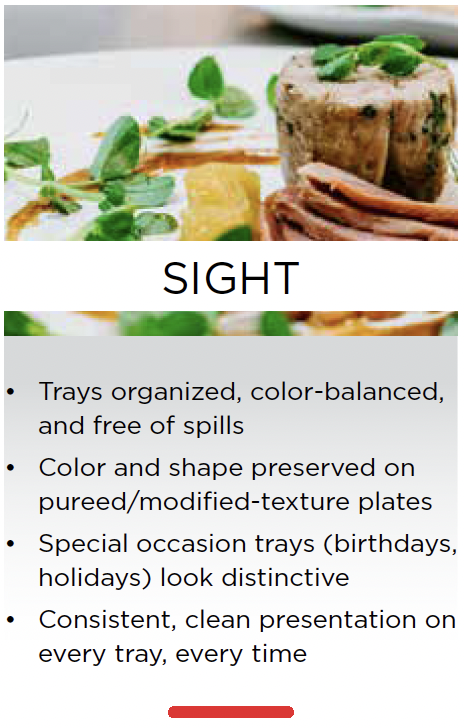
Guests eat with their eyes first. A tray that’s organized, color-balanced, free of spills, tells someone their meal (and they themselves) mattered enough to get it right. In long-term care and assisted living this might mean checking that a pureed diet still has appealing color and shape instead of looking like a single beige mound. It might mean making sure a birthday tray looks different from every other tray that day. In a school cafeteria, it may mean a serving line that looks fresh, inviting instead of picked over late in the period, with produce that is rotated. It should never look tired. In corrections, where presentation options are more limited by security and equipment, it can still mean consistency: trays that look the same, clean, complete, every time, every person. Consistency itself is a form of respect. It tells someone they haven’t been forgotten.
After many years, I still have a visual of my hospital tray being brought to me by a dietary aide the day after I had my first baby. It happened to be Mother’s Day and she said “Happy Mother’s Day to you, mama!” while handing me a tray with a flowered Mother’s Day liner. I immediately burst into tears of joy!
A practical case study: in one senior living community, the team noticed pureed trays were technically correct but visually discouraging. The food met the diet order, the temperatures were logged, and the portions were right, but the plates were beige and flat. During a short tray-line huddle, the CDM, CFPP asked staff to look at the tray as if it were being served to their own parent. That one question changed the conversation. Staff began separating colors, smoothing portions, adding approved garnishes, and checking plate rims before service. Nothing about the menu changed, yet the appeal of the tray improved.
SOUND
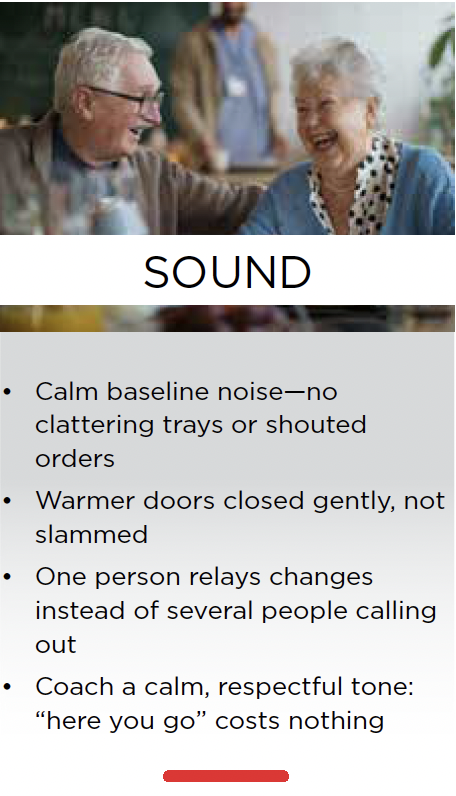
Think about what your guests hear during a meal. Is it clattering trays and shouted orders? Is there a baseline of calm? In a memory care unit, unexpected loud noises can be disorienting, even frightening. They can turn a meal into a source of anxiety instead of comfort. In a school, the sound of the cafeteria sets the tone. Lunch should feel like a break, not another stressor on an already loud day. In corrections, where structure and control are essential and cannot be compromised, your team’s tone of voice is still something you can coach. A calm, respectful “here you go” costs nothing, takes no extra time, yet changes how the moment lands for the person receiving it.
I have trained teams where the biggest hospitality breakthrough had nothing to do with the food. It was the noise. We stood in the dining room before service and simply listened. Trays were hitting counters, staff members were calling across the room, and the room felt rushed before the first guest sat down. We practiced lowering voices, closing warmer doors instead of letting them slam, and using one person to communicate changes instead of three people shouting updates. The dining room did not become silent, and it should not have. It became calmer. Guests could hear the greeting. Staff could hear each other. The meal felt less stressful before anyone took a bite.
SMELL
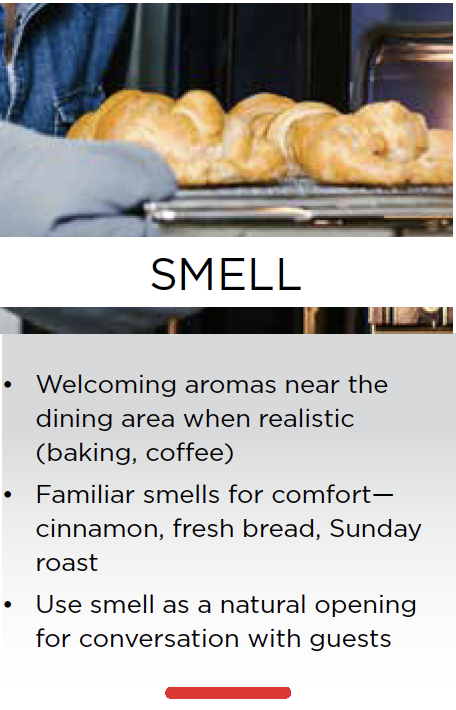
Smell is the sense most closely tied to memory. The aroma of something baking or coffee brewing can do more to make a space feel inviting than almost anything else you control. In senior living, familiar smells like cinnamon, fresh bread, or a Sunday roast can be genuinely comforting. Residents living with cognitive decline sometimes find these smells reach them in ways conversation no longer can. Encourage your team to think about what’s cooking near the dining room, not just in the back kitchen, whenever your setting and your equipment allows.
One hospitality case that stayed with me involved a resident who rarely came to the dining room for breakfast. The team knew she had once baked for her family every Saturday morning. When cinnamon rolls were on the menu, the smell carried down the hallway before trays were passed. That morning she paused near the doorway, asked what was baking, and stayed for coffee. The cinnamon roll was not magic. The smell was a bridge. It gave staff a natural opening to talk with her about something familiar, and for that meal she was not just receiving food; she was being met as a whole person with memories, preferences, and a history.
TASTE
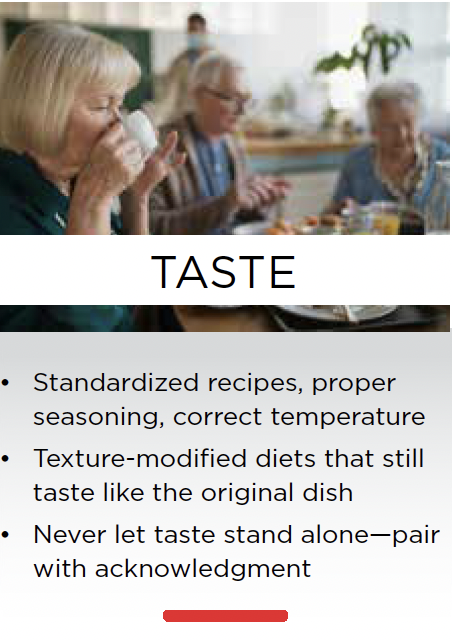
This is the one CDM, CFPPs are already trained to obsess over. For good reason: taste is where your technical skill lives. Standardized recipes, proper seasoning, correct temperature, and texture-modified diets that still taste like the original dish are all squarely within your scope of practice. Don’t let taste become the only sense you manage. A perfectly seasoned pureed meal served cold, late, or without a word of acknowledgment still misses the larger goal. Taste alone doesn’t tell someone they are cared for. It just tells them the kitchen did its job.
FEELINGS
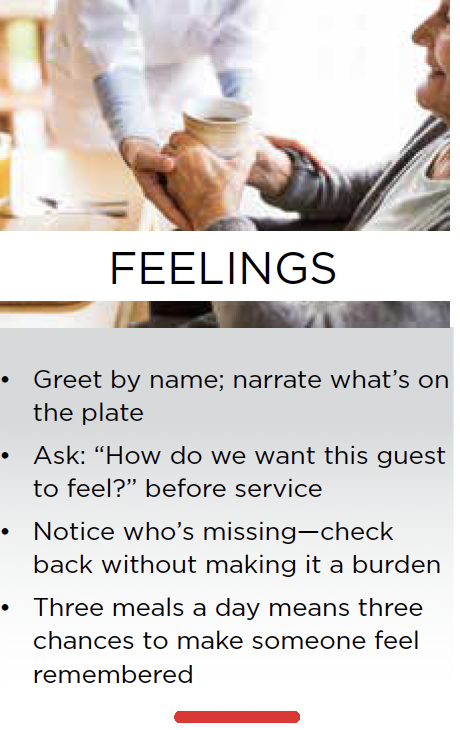
This is where hospitality lives. Ask your team: when a guest receives their meal, how do we want them to feel? Welcomed. Remembered. Not like a task to check off a list. Food is one of the few things you get to give someone multiple times a day, every day. Each time is a chance to make them feel they matter. That’s true whether you’re serving a resident who has lived through decades of history, a student navigating a hard day, or someone in custody whose choices have been taken away in nearly every other part of their life. The tray you send out may be the one thing today that says: you are still worth taking care of.
In every one of these settings, dignity is often communicated through small, repeatable moments rather than grand gestures. Mealtime happens three times a day. You have three chances each day to get it right.
A healthcare hospitality study of travelers receiving medical care found that hospitableness, social atmosphere, and the sense of not feeling alone were connected to positive emotions and perceived coping and healing (Suess, 2025). That matters for CDM, CFPPs because dining rooms and tray delivery are social spaces, even when they are brief. A guest may not remember the exact sodium level or the production sheet behind the meal, but they may remember that someone used their name, noticed they were missing from lunch, or came back with hot coffee without making them feel like a burden.
MAKING IT PRACTICAL
None of this requires a bigger budget or more staff. It requires intention. It requires you to train your team the same way you train them on sanitation and portion control. In-service training on hospitality isn’t a nice-to-have; it’s part of what you’re already scoped to provide. The CDM, CFPP Scope of Practice specifically lists providing, keeping record of education and in-service training for staff under Personnel and Communications, right alongside sanitation, safety, and customer service. Hospitality training belongs on that same list. Documenting it protects you at survey time.
In long-term care and assisted living, coach staff to greet residents by name before setting down their tray. Have them narrate what’s on the plate the way a server would in a restaurant. In schools, keep the serving line moving. Train staff to make eye contact and use a student’s name when they can. Speed and warmth aren’t mutually exclusive.
In corrections, focus your team’s energy on consistency, respectful tone, and accuracy of the tray. Those are the hospitality levers still fully within your control.
Here’s how to put the full framework into action this month. Pick one sense per week for a four-week in-service series with your team. Walk the tray line together. Ask what a guest would see, hear, smell, taste in that moment. Close each session by asking the harder question: how do we want them to feel? Document the training the way you would any other in-service. Revisit it quarterly. Hospitality habits fade the same way any other habit does without reinforcement.
Putting this idea into practice, we recently wrapped up a Hospitality Training series in a healthy quick-service restaurant brand I work with. I honed my acting skills and gave the employees a show of “what NOT to do” when a guest walks down the line. I rolled my eyes when they walked up, bit my cheeks not to smile, asked “what do ya need?” I sloppily prepared their food while I took a phone call and drank my coffee.
The message hit home. We asked them: “what did she do wrong?” They all stated they felt uncomfortable and unwelcome. It didn’t matter that their food looked and tasted delicious. My unhospitable attitude left them feeling they would never return if this was a real-life scenario.
I have used that same idea with healthcare and senior living teams by asking staff to act out both versions of tray delivery. First, they rush in, avoid eye contact, set the tray down, and leave. Then they repeat the same tray with a name, a description, a check for comfort, and a closing question. The room always notices the difference. Staff laugh during the role-play, but the lesson lands because they feel it in their own bodies. No one wants to be treated like an interruption. Once staff experience that discomfort themselves, they are much more likely to protect residents and guests from it.
Another training tool that works well is the “lonely table” exercise. Ask one employee to sit alone at a table while everyone else moves around the room completing tasks. No one is rude to them. No one says anything unkind. They are simply ignored for two minutes. Then ask how it felt. Most people say some version of invisible, awkward, or forgotten. That is the point. Loneliness is not always created by cruelty. Sometimes it is created by speed, task-focus, and silence. Hospitality interrupts that pattern with small moments of recognition.
Whatever setting you manage, you didn’t get into this field just to balance a budget and pass a survey. You got into it because food matters to people. You are in a position to make sure it shows. The five senses (sight, sound, smell, taste, feelings) are simply a framework for making sure that intention reaches the tray.
Every guest deserves to feel like more than a number on a census. You already have the tools to make that happen. You can extend the hospitable environment and culture to your teams who will share that with your guests.
About the Author
Kristin Klinefelter, MS, RDN, LDN
Kristin Klinefelter teaches, consults, and leads with a hospitable touch. Her favorite side hustle is running a retreat business, where she creates cozy, welcoming spaces and brings in a trained chef who shows guests love through food. Working quietly behind the scenes, she makes sure every guest feels at home, leaving each one rested and energized at the same time.