This Management Connection CE article appeared in the May/June 2026 issue of Nutrition & Foodservice Edge magazine. To view a PDF of this article click HERE.
ANFP members can earn 1.0 GEN CE for 20% off with this article through May 12, 2027, thanks to our sponsor, CJ Schwan’s.

To earn 1.0 GEN CE credit, purchase the CE article in the ANFP Marketplace HERE or click the button below and complete the quiz.

This course is a level III continuing competence. View continuing competence level descriptions HERE.

AI, Apps, and Automation: Preparing the CDM, CFPP for the Digital Future of Food Service
By: Kristin Klinefelter, MS, RDN, LDN
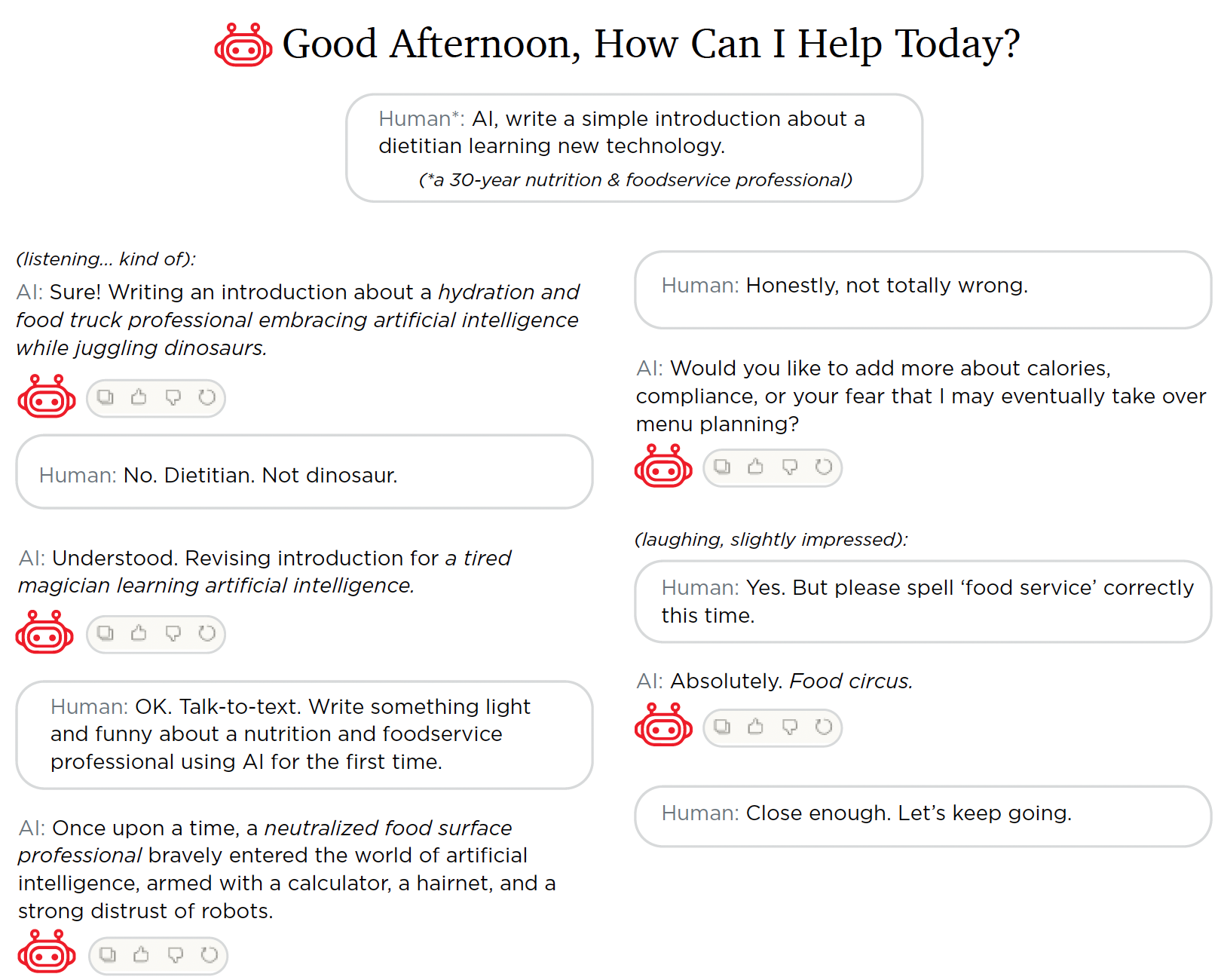
Does this type of parasocial conversation sound familiar? My personal and professional relationship with artificial intelligence (AI) has evolved rapidly; from using a conversational voice assistant (Siri) while driving to relay after school instructions to my children, to working alongside desktop AI systems that now organize files, draft policies, and streamline administrative tasks in minutes rather than hours.
A similar transformation has occurred across the foodservice industry. Back in the late 1900s (a phrase I like to begin my stories with, which makes me look archaic in my students’ eyes), I worked for a major foodservice distribution company and drove two to four hours to manually take CDM, CFPP’s/DTR’s/RD’s weekly truck orders. Now they have the option for automated inventory, PAR management and ordering, which gives professionals the gift of time to focus on other tasks. Over the past decade, advances in artificial intelligence, mobile applications (apps), automation systems, and predictive analytics have fundamentally reshaped how the Certified Dietary Manager, Certified Food Protection Professional (CDM, CFPP) plans menus, monitors operations, trains staff, enhances food safety, and supports client-centered care. These tools now influence nearly every aspect of nutrition and foodservice management.
For CDM, CFPPs, the rapid emergence of digital tools directly intersects with the CDM, CFPP Scope of Practice and Code of Ethics — both of which emphasize safe, high quality, efficient, and person-centered care (ANFP, 2023a; 2023b). When implemented responsibly, technology enables CDM, CFPPs to improve outcomes, reduce waste, personalize dining experiences, and strengthen team performance, while maintaining ethical integrity and professional accountability.
THE DIGITAL TRANSFORMATION OF FOOD SERVICE: TECHNOLOGY IN DAILY OPERATIONS
AI, apps, and automation are no longer futuristic concepts; they are already embedded in healthcare and long-term care food service. We have real-time demonstration as well as research that AI-driven tools for food waste tracking, menu optimization, and inventory forecasting improve operational efficiency and environmental sustainability.
In practice, these innovations may be as simple and powerful as a Bluetooth enabled digital thermometer linked to a daily food safety checklist. When temperatures fall outside safe ranges, the system can prompt corrective actions in real time. This type of guided automation functions like a simplified, interactive HACCP plan, clear enough for a first-time foodservice employee to follow accurately, while still meeting regulatory expectations. Have too much food at the end of your production day? There’s an app for that! The app coordinates selling low-cost meals or ingredients to consumers from retailers that have waste at the end of the day. Consumers can browse the options on the app and order for pick-up at a designated time. Foodservice operators feel good about their waste going to individuals who value sustainability or are struggling with food insecurity.
ChatGPT has become one of those acronyms we mention casually, often without stopping to consider what it means. I realized recently that I couldn’t even define “GPT.” The term stands for Generative Pre-trained Transformer, a type of artificial intelligence trained on large volumes of existing information to generate human-like responses.
Not long ago I polled a variety of nutrition and foodservice professionals about how they use AI, apps, or automation in their workplace, and received a wide range of responses:
- Forecast purchasing and production needs with your prime vendor software upgrades. “At first I mistrusted the purchasing models, but now that I have embraced the software, I have a few hours back in my week!” reports a 20-year CDM, CFPP.
- Reduce pre- and post-consumer food waste by creating production and preparation lists. An RDN reports incentivizing her team with a waste reduction contest. They use AI to generate their spreadsheet and create charts to visualize which shift has the lowest waste in dollars. Her team also reported using ChatGPT to create their team names. There are some very fun team names like The Leftover Legends and The Lean Green Cuisine Team.
- Identify allergen and cross-contact risks. When the FDA officially added sesame as a top allergen, a CDM, CFPP was able to locate all sesame products in her spring menu with one question to her desktop AI program.
- Track client preferences and dining patterns. An RDN gave the example of tallying survey results into a chart that was AI-generated for a quick menu planning meeting graphic.
- Expand recipes. One CDM, CFPP reported faster results by using AI to generate formulas in a spreadsheet for recipe modifications with changing RSVPs or census.
- Fine-tune or polish professional communications. One administrator called ChatGPT her “thought partner” and uses the technology to quickly revise her emails or group messages. A director of an education program reports: “I often use it to reword or organize emails or meeting minutes. I tweak everything it gives me and don’t put my full trust in it.”
- Create educational materials or brainstorm presentation ideas. When looking for quick handouts with assessment questions to validate learning, a CDM, CFPP responded that “AI makes appropriate and visually simple handouts that are helpful for quick in-services.” She reported that it’s always important to verify that all information is evidence-based and accurate.
- Utilize apps for patient success. One outpatient dietitian reports: “I use apps with my patients. There are helpful apps for continuous glucose monitoring (CGM), sleep, exercise, and food tracking. I always review what ChatGPT gives me for accuracy and tailor to the patient’s needs.”
Commonly used foodservice technologies include AIenhanced menu planning systems, inventory and purchasing platforms, and waste tracking tools. While adoption levels vary by facility, industry trend reports indicate growing reliance on digital forecasting, automated menu engineering, and AI-supported inventory controls (Datassential, 2024).
SCOPE OF PRACTICE: WHERE TECHNOLOGY FITS
Within their Scope of Practice, CDM, CFPPs play key roles in menu implementation, safe foodservice operations, staff training and supervision, quality assurance, and client engagement (ANFP, 2023a). Today’s digital tools fit naturally within these responsibilities by streamlining nutrition analysis, simplifying compliance documentation, improving onboarding and continuing education processes, and supporting more accurate forecasting for inventory and production. CDM, CFPPs have always balanced clinical accuracy with hospitality-driven care, and technology simply strengthens their ability to do so. Importantly, technology enhances but never replaces professional judgment. CDM, CFPPs remain responsible for validating AI outputs and ensuring that decisions are ethical, clinically appropriate, and person-centered. A robot or algorithm cannot replicate the caring CDM, CFPP who brings a warm meal to a family member sitting bedside or offers a listening ear to a staff member. These moments of empathy remain central to our profession.
MENU PLANNING AND NUTRITION ANALYSIS
AI-supported menu planning systems are increasingly capable of analyzing nutrient patterns, allergens, cost fluctuations, and client preferences all at once. At Lincoln Gardens Senior Living (fictitious for storytelling purposes), the implementation of an AIenhanced menu system reduced the time needed to develop a full menu cycle from three weeks to one, while also improving allergen tracking accuracy. The department also noted steady improvements in client satisfaction because the software allowed them to customize menus more efficiently and offer better variety. CDM, CFPPs can further enhance these systems by reviewing AI-generated menus for cultural accuracy, therapeutic diet requirements, and seasonal ingredient considerations.
CLIENT MEAL ORDERING APPLICATIONS
Tablet and kiosk-based ordering platforms have proven especially effective in increasing autonomy and reducing diet order errors. Visual menus with large-font text and high-quality photographs increase engagement, particularly for older adults or individuals with cognitive limitations. At Maple Ridge Care Center (another fictitious facility), the use of a meal-ordering app significantly reduced tray error while boosting dining participation among clients. The software’s photo-based options empowered clients to make real-time choices, and families expressed appreciation for the clarity and ease of use.
Practical Tips and Tricks for CDM, CFPPs
- Work with your technology teams (or honestly a young team member who understands apps) to tailor and customize graphics and visuals on all materials and apps.
- Create QR codes for all menus, ordering platforms, and special event details. You can do it! (Or again, ask someone who is knowledgeable about this technology to coach you.)
- Use built-in analytics to identify unpopular menu items that may contribute to waste.
INVENTORY AUTOMATION AND WASTE REDUCTION
AI-driven waste tracking platforms are becoming valuable tools for sustainability and cost control. These systems categorize plate waste, track trends over time, and forecast purchasing needs to prevent both shortages and overproduction. CDM, CFPPs who integrate portion photographs or step-by-step plating guides can standardize serving sizes and reduce unnecessary waste. Reviewing waste dashboards during monthly staff meetings provides a meaningful way to keep teams informed and motivated. Publicly celebrating reductions, no matter how small, helps reinforce a culture of continuous improvement.
Practical Tips and Tricks for CDM, CFPPs
- Use photos to standardize portions and reduce overproduction.
- Track high-waste menu items and adjust recipes or placement. Implement batch cooking based on real-time production predictions.
- Post dashboards showing weekly waste trends to keep staff engaged.
- Celebrate “Zero Waste Champions” monthly to reinforce positive behaviors.
TRAINING TEAMS TO USE TECHNOLOGY EFFECTIVELY
Effective technology adoption requires targeted training that respects how adults learn: through relevance, hands-on practice, and real-world application. Simulation-based training is especially valuable for practicing digital tasks in a low-pressure environment. CDM, CFPPs can create simulations for tasks such as digital diet order entry, responding to alerts, navigating ordering apps, or handling online production sheets.
Peer mentoring strengthens adoption by pairing experienced tech users with new staff members. Microlearning modules delivered through a Learning Management System (LMS) allow staff to complete short, meaningful lessons during shift lulls.
Practical Tips and Tricks for CDM, CFPPs
- Use 5–10-minute microlearning videos on key tech tools.
- Provide “practice tablets” so staff can explore apps during downtime.
- Build simulations that mirror real service challenges (we used to call this role play or case studies).
- Pair tech-savvy staff with new employees as digital mentors.
- Offer recognition (digital badges, certificates) for tech competency milestones.
ENHANCING SPECIAL EVENTS AND MENUS WITH TECHNOLOGY
Technology can elevate themed meals, wellness events, and cultural celebrations. QR codes on menus or table tents link to nutrient highlights, cultural histories, allergen information, or videos of traditional meal preparation. AI platforms can also suggest seasonal ingredients, generate cost-optimized themed menus, and provide playlists or décor ideas.
Imagine a “Mediterranean Wellness Week,” where QR codes on menus provided nutrient education, an AI-curated playlist played during meals, and digital surveys captured feedback instantly. The results could be increased participation and highly positive dining satisfaction trends.
Practical Tips and Tricks for CDM, CFPPs
- Add QR codes to special event menus linking to fun facts or nutrition insight.
- Use AI to generate culturally-diverse menu ideas aligned with your clients.
- Offer digital surveys for quick feedback after events.
- Curate themed music playlists to enhance atmosphere.
- Include clients in planning by using app-based polls to choose meal themes.
TECHNOLOGY IN CLIENT EDUCATION
Interactive nutrition apps allow clients to explore food substitutions, visualize portion sizes, and build simple recipes. These tools align with person-centered education principles and support clients in managing their own health at their own pace.
While waiting at an Apple retail location with my daughter, I watched a “How to Use Your Apple Watch” class filled with older adults, most appearing to be in their mid-to-late 70s. They were engaged, laughing, and learning enthusiastically. This joyful approach to digital learning can be replicated in senior living environments through short, accessible tech sessions.
CDM, CFPPs can offer brief workshops such as “How to Use the Menu Ordering App” or “How to Understand Your Nutrition Recommendations.” These sessions empower clients while reinforcing choices. Printed menus, verbal prompts, and assisted ordering should remain available for anyone who prefers them.
Practical Tips and Tricks for CDM, CFPPs
- Host 15-minute “Tech & Treats” sessions with simple tutorials and snacks.
- Offer optional one-on-one tech assistance for clients who are hesitant.
- Use tablets during nutrition education classes for interactive learning.
- Provide “loaner devices” for practice in the dining room.
- Maintain printed alternatives to ensure every client has access.
DESIGNING EFFECTIVE TECHNOLOGY PRESENTATIONS
Whether presenting to leadership, staff, or clients, CDM, CFPPs must tailor their message to each audience’s priorities. Leaders often seek measurable outcomes such as waste reduction or cost savings. Staff members want to understand workflow improvements and ease of use. Clients typically value convenience and autonomy above all.
Dashboards with simple visuals communicate improvements effectively, while storytelling adds context and humanizes the data. Sharing anecdotes, such as a client who began eating more consistently after using a photo-based ordering app, helps illustrate the meaningful benefits of these tools.
Practical Tips and Tricks for CDM, CFPPs
- Use before/after metrics when presenting to leadership.
- Build simple job aids for staff that fit on a single page. Use large-print visuals when presenting to clients and families.
- Pair data with success stories to improve buy-in.
- Demonstrate tools live rather than describing them verbally.
CONCLUSION: THE HUMAN AND DIGITAL FUTURE
AI, mobile applications, and automation are powerful tools that enhance, rather than replace, the expertise of CDM, CFPPs. When aligned with the CDM, CFPP Scope of Practice and Code of Ethics, these technologies strengthen quality, safety, efficiency, and client satisfaction.
By approaching digital transformation with ethical awareness, strategic planning, and intentional staff training, CDM, CFPPs are uniquely positioned to lead foodservice departments into a future that is efficient, engaging, and deeply human.
About the Author
Kristin Klinefelter, MS, RDN, LDN
Kristin Klinefelter has evolved with her use of AI, apps, and automation since 1998 in the nutrition and foodservice industry. Back in the late 1900s, she drove from facility to facility with sticky notes on her dashboard and made multiple stops to respond to her beeper. Now, she can have a full conversation with Siri, create calendar events, and talk-text her next article while driving to a foodservice operation or convention to speak with real people.