This Management Connection CE article appeared in the November/December 2025 issue of Nutrition & Foodservice Edge magazine. To view a PDF of this article click HERE.
To earn 1.0 GEN CE credit, purchase the CE article in the ANFP Marketplace HERE or click the button below and complete the quiz.

This course is a level III continuing competence. View continuing competence level descriptions HERE.

Supporting Mental Wellness: Combating Stress and Burnout
By Kristin Klinefelter, MS, RDN, LDN
A CDM, CFPP HAS A CRITICAL ROLE in health care and food service, balancing leadership, nutrition expertise, and the well-being of both staff and clients. This responsibility often comes with significant stress and, for many, the risk of burnout. According to the American Institute of Stress, workplace stress is a major concern, with 83 percent of U.S. workers reporting it as a cause for concern and nearly 23 percent experiencing burnout “very often or always.” In the dietary management field, these numbers may be even higher due to the unique pressures of managing teams, meeting regulatory demands, and ensuring quality care.
The importance of mental wellness, especially during the holiday season, which brings its own set of triggers, cannot be overstated. This article offers practical, evidence-based strategies to help CDM, CFPPs recognize signs of stress and burnout, take proactive steps for mental health, and build a culture of wellness both for themselves and those they lead.
RECOGNIZING STRESS AND BURNOUT: SYMPTOMS AND STATISTICS
Stress and burnout manifest in many ways, some obvious, others subtle. Common symptoms include persistent fatigue, irritability, difficulty concentrating, changes in appetite or sleep patterns, and a sense of detachment from work or colleagues. Burnout, as defined by the World Health Organization, is a syndrome resulting from chronic workplace stress that has not been successfully managed. For CDM, CFPPs, signs might include emotional exhaustion, cynicism or negativity toward tasks, and a drop in professional efficacy.
Take Linda, a fictional CDM, CFPP in a long-term care facility. She found herself snapping at staff over minor mistakes and waking up at 3 a.m. worrying about menu substitutions. Her “aha moment” came when a resident gently asked if she was okay after she delivered lunch looking frazzled. That was the push she needed to take her own wellness seriously. (Spoiler: she now walks during her lunch break and swaps her third cup of coffee for herbal tea. She swears she’s less likely to email people in ALL CAPS.)
Leaders are not immune: a 2023 survey by Mental Health America found that 75 percent of managers experience workplace stress, and 60 percent report feeling burned out. Left unaddressed, these issues can contribute to absenteeism, decreased productivity, and even more serious mental health crises.
HOLIDAY TRIGGERS AND SEASONAL STRESS
The holiday season, while joyful for many, can amplify stress for CDM, CFPPs and their teams. Increased workloads, staffing shortages, and the pressure to create festive experiences for clients can lead to emotional and physical fatigue. Additionally, personal challenges such as family obligations, grief, or financial pressures can heighten anxiety.
Consider Marco, a fictional CDM, CFPP in a hospital setting. December hits, and suddenly he’s juggling staff potlucks, a short-order request from the nursing director, and a last-minute food delivery snafu. His strategy? He sat down with his team, laughed about the chaos (“If one more person asks for gluten-free fruitcake, I’m retiring early”), and then delegated tasks more equitably. His lighthearted leadership turned stress into teamwork, and morale improved across the board.
INTEGRATING LONGEVITY LESSONS INTO HOLIDAY WELLNESS
The holidays can be a particularly challenging time for foodservice professionals, and insights from The Blue Zones offer practical lifestyle habits that support mental well-being. Beyond the well-documented benefits of balanced eating and moderation, these communities emphasize time in fellowship and rest. Research shows that spending at least an hour a week in meaningful community connection improves mental resilience and reduces the risk of depression (Holt-Lunstad et al., 2015). For CDM, CFPPs, this may mean intentionally scheduling peer check-ins, participating in professional networks, or fostering supportive workplace gatherings, even during busy holiday periods.
EVIDENCE-BASED PRACTICES FOR WELLNESS
Managing stress and supporting mental wellness require a toolkit of strategies. Here are some evidence-based practices CDM, CFPPs can incorporate into their daily lives:
Mindfulness and Breathing Techniques
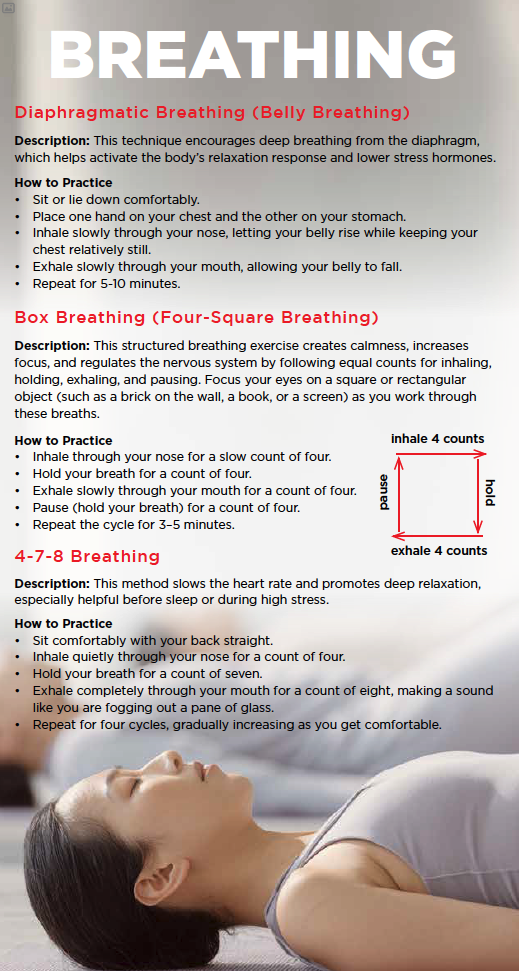
Mindfulness, the practice of staying present and nonjudgmental, has been shown to reduce anxiety and improve emotional regulation. Even a few minutes of deep breathing can activate the body’s relaxation response. Try this simple exercise: Inhale deeply for four counts, hold for four, exhale for four, and pause for four. Repeating this three to five times can help relax the body. (See more breathing techniques in the pop-out box.) This takes about 64 seconds and will allow you to come back to the situation with a calmer approach. As we often say in food service, “unless your kitchen is on fire, you don’t have to solve this problem immediately!” Mindfulness-based stress reduction (MBSR) programs have also been shown to decrease burnout and improve resilience among healthcare professionals (Lamothe et al., 2016).
Trina, another fictional CDM, CFPP, found herself constantly on edge. She started practicing box breathing before staff meetings. (Box breathing is described in the breathing pop-out box.) Now, her team jokes that she’s gone from “volcano Trina” to “zen Trina.” She laughs right along with them, and her meetings run more smoothly.
Quality Sleep
Good sleep is foundational for mental health. The CDC recommends adults aim for 7-9 hours per night. Establishing a calming bedtime routine, eliminating screen time two hours before bed, and maintaining a consistent sleep schedule can make a significant difference. Adults who consistently fall short of seven hours are at higher risk for impaired concentration, irritability, and emotional exhaustion.
Nutrition for Resilience
As a dietary professional, you know the role of nutrition in overall health. During periods of stress, prioritize balanced meals, hydration, and regular eating patterns. Avoid excessive caffeine and processed foods, which can exacerbate anxiety and disrupt sleep. Diets rich in whole grains, vegetables, and healthy fats, hallmarks of the Blue Zone lifestyle, are also linked to lower rates of depression and better overall cognitive function (Jacka et al., 2017). Similarly, the Mediterranean diet, which shares many of these principles, has been shown to support heart and brain health while reducing the risk of chronic disease (Mayo Clinic Diet, 2025).
Exercise and Movement
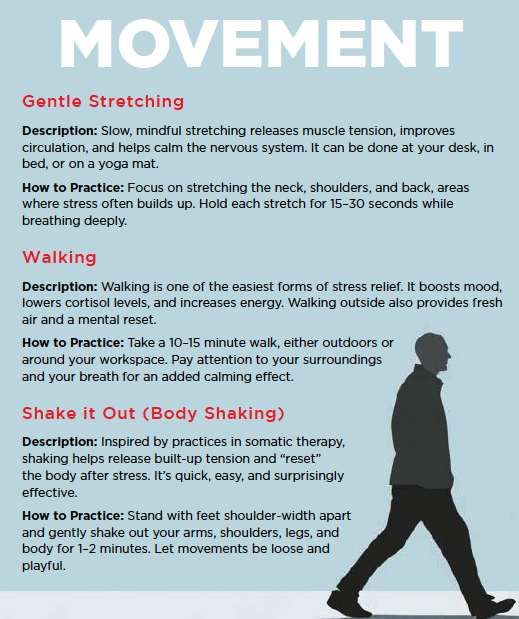
Physical activity is a proven stress reliever. Just 15-20 minutes of walking can release endorphins, which are natural mood lifters. Even short walks, stretching, or gentle desk exercises can elevate mood and energy. The American Psychological Association notes that exercise reduces fatigue, improves alertness, and enhances overall cognitive function (APA, 2018).
Community and Social Support
Connection is a powerful buffer against stress. Lean on your professional network, family, and friends. Consider joining or forming peer support groups within your workplace to share experiences and coping strategies. These social bonds not only improve mood but also support long-term resilience.
Self-Care Before Caring for Others: The Oxygen Mask Analogy
“You can’t pour from an empty cup.” The airline instruction to “put on your own oxygen mask before assisting others” is more than a metaphor, it’s essential for foodservice professionals who lead teams and care for vulnerable populations. Behavioral psychology research and stress surveys consistently show that leaders who model self-care foster healthier, more resilient teams.
Or as Marco quipped after finally taking a Saturday off to go fishing: “Turns out the facility didn’t burn down without me. Who knew?”
Hara Hachi Bu: Enough Is Enough
The Japanese phrase “hara hachi bu” means “eat until you are 80 percent full,” a practice associated with longevity in Okinawa’s Blue Zones. But its wisdom applies beyond the dinner table. In work and in life, recognizing “enough is enough” helps prevent overextension and burnout.
Applying hara hachi bu to daily routines might mean setting boundaries on work hours, declining extra responsibilities when capacity is reached, or practicing moderation in expectations, both for yourself and others.
ADOPT AN ONGOING COMMITMENT TO SELF-CARE AND SUPPORT
In the words of author Audre Lorde, “Caring for myself is not self-indulgence, it is self-preservation, and that is an act of political warfare.” As a CDM, CFPP, your mental wellness is foundational, not just for your own health, but for the countless lives you touch.
Take time to check in with yourself, practice evidence-based strategies, and seek support when needed. Lead by example, foster a culture of care, and remember: “Enough is enough.” Ongoing self-care is not a destination, but a journey, one that benefits you, your team, and your community.
Call to action: Prioritize your own wellness, encourage open conversations, and commit to making mental health a central part of your professional practice — not just during the holidays, but every day of the year.
About the Author
Kristin Klinefelter, MS, RDN, LDNKristin Klinefelter has made efforts to surround herself with a community of people from a variety of backgrounds to constantly be learning about and practicing wellness. Whether she is leading a workshop at a wellness retreat or speaking to a group of professionals at a conference, she focuses on practical and sustainable suggestions to improve people’s quality of daily life.