This Culinary Connection CE article appeared in the February 2026 issue of Nutrition & Foodservice Edge Express. To view a PDF of this article click HERE.
To earn 1.0 GEN CE credit, purchase the CE article in the ANFP Marketplace HERE or click the button below and complete the quiz.

This course is a level II continuing competence. View continuing competence level descriptions HERE.

The Importance of Standardized Recipes
By: David Volez, CEC, CWPC, CCA, WCEC, CDM, CFPP, FSWC, FMP, CHIA
LIKE EVERYONE ELSE, I HAVE HAD SOME MOMENTS THAT STAND OUT in my culinary journey that made a significant impact. One such moment happened when I was a young chef, not too long out of culinary school, and decided to take the plunge into ACF (American Culinary Federation) competition cooking. Knowing next to nothing about competition cooking, I entered a Mystery Box Competition.
I remember two distinct things. One, I did very badly at the competition. Two, I recall the words of the Master Chef judge who gave us all a critique. We had all received stone-ground grits in our basket. Our misfortune/fortune was that Chef had lived in Charleston, S.C. for a number of years. The home of shrimp and grits. I remember him shouting at all of us, repeating over and over again in his German accent, “What is the standard?! Three to one! Three to one, with a little bit of cream!” We had all missed the mark on our grits because we did not know the standard.
This, along with many other experiences, solidified in my mind the need for, and adherence to, standardized recipes. Though I’m sure you can cite many reasons why standardized recipes are integral to our business, I’ll focus on three.
CUSTOMER SATISFACTION
How often have we heard a customer say, “Last time I was here and ordered this, it tasted better?” Or maybe the opposite is true and the last time they dined with you they thought it was bad, but gave it another try and this time it’s actually good! Either way, it’s disappointing and embarrassing. Consumers thrive on consistency — both in experience and in product. How else have fast food restaurants flourished over the past 60 years? Because people recognize that when they leave on a trip from Alabama, when they reach the chain restaurant in their town in Ohio, they know what they’re going to get. Standardized recipes are the key to ensuring each entrée, condiment, side dish, and dessert comes out just like they did in another state, or on both Tuesday and Wednesday.
At my current job, we had a dining venue that was largely unused for this reason. Our residents came to equate dining there with a game of roulette. They never knew if the food was going to be good, let alone the same as the last time they ate there. We undertook some core work to make sure that standardized recipes existed for each dish and component. Another part of the fix was to have pictures of the dish in each station to ensure we were serving to the same standard each time.
COST CONTROL
At the end of the day, it’s about keeping as much money in our business as we can. Standardized recipes are always the start of how we put these controls in place before an item ever gets to the menu. We go through development to ensure that each ingredient is carefully measured to achieve the desired outcome. Next, we pull out our invoices and order guides and begin the math to understand what a batch will cost to produce. Then we do some additional ciphering to break that down into cost per serving. This helps us know how to price our menu items to ensure we are achieving the margins we need to meet our financial goals. The danger in this from a practical perspective is when we make a batch of something so often without using a reference, we fool ourselves into believing we are making it the same each time.
Recently, I’ve begun a journey to become a private pilot. We use two very important tools when flying called ‘flows’ and ‘checklists.’ A f low is something that we do from memory that often involves a mnemonic. One we use before landing is called ‘GUMPS.’ It stands for gas, undercarriage, mixture, props/power, and switches. We go through this flow, calling out each part and touching it to ensure compliance. However, with each flow is a corresponding checklist. The checklist is what we read through before our final run committing to an action. This ensures we didn’t miss anything that we thought we had stored in our memory.
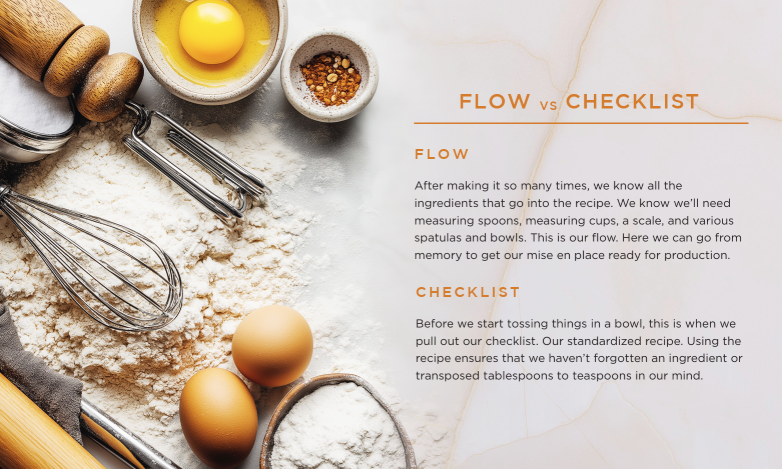
The same applies when making a recipe. After making it so many times, we know all the ingredients that go into the recipe. We know we’ll need measuring spoons, measuring cups, a scale, and various spatulas and bowls. This is our flow. Here we can go from memory to get our mise en place ready for production. However, before we start tossing things in a bowl, this is when we pull out our checklist. Our standardized recipe. Using the recipe ensures that we haven’t forgotten an ingredient or transposed tablespoons to teaspoons in our mind. The main point is that we are protecting and ensuring that the bottom line is being adhered to and we are putting the exact amount of money in each batch.
NUTRITIONAL ADHERENCE
Most of us that belong to ANFP and are proudly certified with the CDM, CFPP credential have some part of our business that includes health care. We all know that to maintain compliance, what’s on the menu must match what’s on the plate. That means there has to be strict adherence to standardized recipes. If we are not following recipes, we are immediately out of compliance. If we are not ensuring that the “checklist” is followed, the best we can do is hope that the final products we are serving to our healthcare patients are close to the nutritionals they are supposed to be served. These play a crucial part in ensuring they are maintaining weight, not gaining weight, are in compliance with the diet they have been ordered, or in extreme cases, do not have ingredients that would cause them harm. With the addition of a ninth key food allergen (sesame), we have to be ever vigilant in ensuring that our compromised populations are not receiving anything that could endanger their lives. A culture of following standardized recipes helps us achieve that.
I used to work in a pretty large hospital. Not the biggest, but certainly not the county hospital. Though I wish I could take credit for the idea, the Executive Chef created a department in the kitchen flow called, “ingredient control.” The sole responsibility of the workers in this section of the kitchen was to receive the standardized recipes from the chefs and the raw materials from the receiving staff on a cart.
For each recipe, they weighed and measured all ingredients according to the standardized recipe. They bagged all the spices together, put oils in sealable containers, and put only the amount of proteins called for in Lexan food containers. When they had completed the recipe, they put the ingredients and recipe back on the cart for the cooks to grab the next day. All extraneous product was returned to receiving for other use. The next day, the cooks came and grabbed their carts. At this point, all they had to do was use the ingredients that were pre-measured by ingredient control and follow the instructions on the standardized recipe. This ensured that an extra dash or splash did not get added to suit the cook’s personal taste. Nutritional adherence was achieved each time according to the standardized recipe.
SUMMING IT UP
Many other reasons and best practices are out there to put standardized recipes into use in our operations. However, these are the ones that have been the most glaring in my experience. If we can build a culture and expectation of using standardized recipes, these three broad areas will most likely cover any other concern we have in our operation. If we pay attention to this process in our kitchens, we set ourselves up for success.
About the Author
David Volez, CEC, CWPC, CCA, WCEC, CDM, CFPP, FSWC, FMP, CHIA
David Voelz is the Senior Director of Dining Services for Glenaire, a continuing care retirement community in Cary, N.C. Here he serves a diverse population of active seniors under the guiding principle, “Strive for perfection, settle for excellence. Perfection is found in the details.”